When Herbert De Paz created a new portrait of Gaspar Yanga, he had no way of knowing where the painting would eventually lead him.
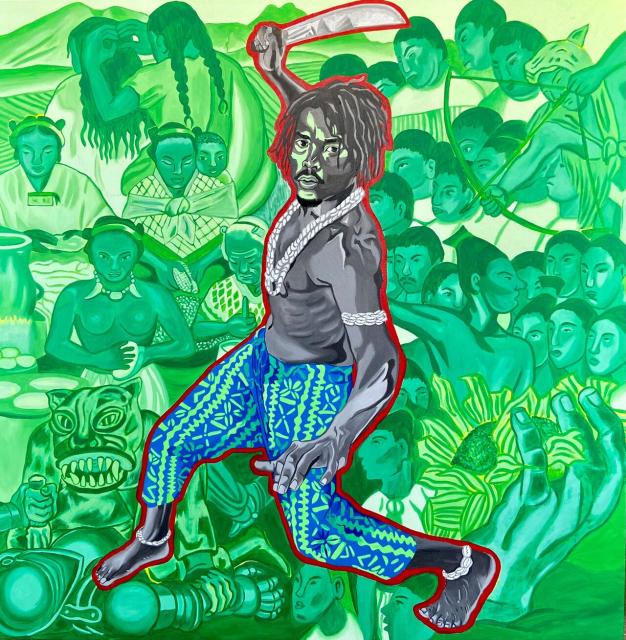
The Salvadoran artist had been researching historical figures whose stories he believed deserved greater recognition when he learned about Yanga, an African leader who resisted enslavement in colonial Mexico. De Paz was struck not only by Yanga’s story, but also by the images that had come to represent him.
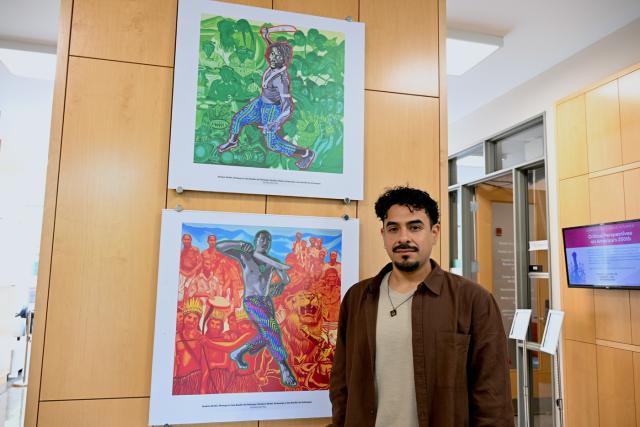
In the portrayals De Paz found, Yanga was often depicted barefoot and wearing white pants, sometimes shown breaking chains — imagery De Paz felt relied on stereotypes. Wanting to reimagine that portrayal, De Paz asked his friend Rafael to model for him, selected African fabric for his clothing and positioned him in a pose somewhere between fighting and dancing.
“I wanted to give Yanga a new face,” De Paz said. “I wanted to refresh this portrayal of Yanga that is commonly on the internet.”
De Paz uploaded the finished portrait to Yanga’s Wikipedia pages in English, Spanish and Portuguese. In 2024, Leila Vieira, assistant director of The Ohio State University’s Center for Latin American Studies, discovered it while searching for artwork for an event about enslaved people in Latin America who fought for their freedom.
Vieira reached out for permission to use the image and continued following De Paz’s work. As she learned more about his exploration of Latin American history, she began thinking about what his work could offer Ohio State students.
“They could learn from these paintings,” Vieira said. “I thought, ‘We’ve got to find a way to bring him to campus.’”
For De Paz, the histories represented in his art are deeply personal. Born in Santa Tecla, El Salvador, he grew up near archaeological sites and other reminders of the country’s Indigenous roots, yet felt disconnected from parts of that history and identity. Those questions eventually shaped an artistic practice exploring Indigenous and African-descended histories and identities.
“I wish someone had told me about the greatness of my ancestors and their cultures."
“I wish someone had told me these stories when I was younger,” De Paz said. “I wish someone had told me about the greatness of my ancestors and their cultures. I want people to know that our ancestors were great and that they deserve to be acknowledged.”
Now, De Paz is using his art to share the histories he once went looking for himself.
That mission resonated with Vieira, who saw his work as a way to introduce students to unfamiliar histories and perspectives through something more immediate than a lecture or textbook. Arts at Ohio State’s Visiting Artist Program offered a way to turn that idea into a broader campus experience.
Two years after Vieira first discovered his work online, De Paz arrived at Ohio State for a two-week residency.
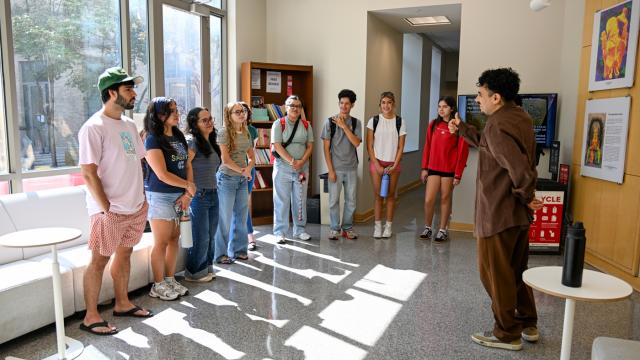
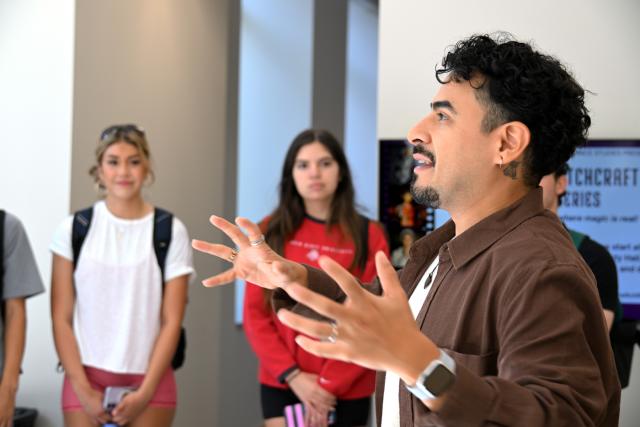
With De Paz’s work on display in Hagerty Hall, students could see the paintings as they moved through the building. The exhibition included works drawing from pre-Hispanic Mesoamerican mural traditions and examining cultural artifacts displaced from their places of origin. De Paz also visited undergraduate and graduate classes, shared his research and led exhibition tours in English, Spanish and Portuguese.
“It would have been easy to bring him to campus, exhibit his work and limit the experience to faculty,” Vieira said. “But I didn’t want that knowledge to stay in a little bubble. I wanted him to interact with as many students as possible, both inside and outside the classroom.”
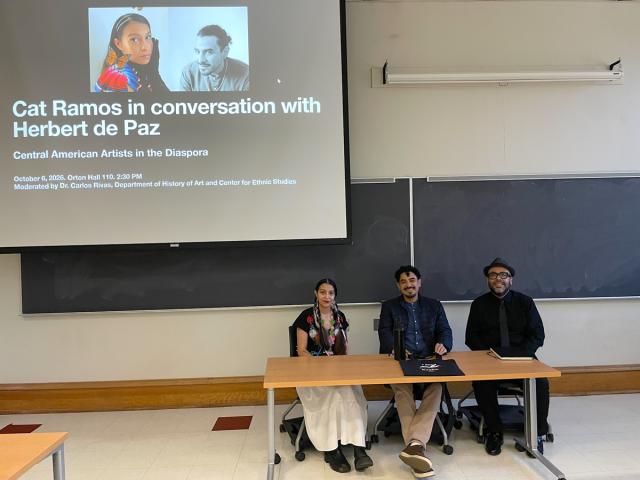
Those interactions extended beyond campus. De Paz joined Columbus artist Cat Ramos for a conversation about Central American art in the diaspora, visited local schools and worked with Ramos and community members to create a painting at the Latino Heritage Month Festival. His work was also featured in a group exhibition at Blockfort Gallery as part of the festival.
For Vieira, the residency offered something different from a traditional academic lecture: an opportunity for art to spark conversations across audiences and disciplines.
“Everyone has a reaction when you put art in front of them,” Vieira said. “They might love it, they might like it, they might be confused by it. You don’t know what you’re going to get, but there is an exchange that happens.”
De Paz sees that exchange as fundamental to his work.
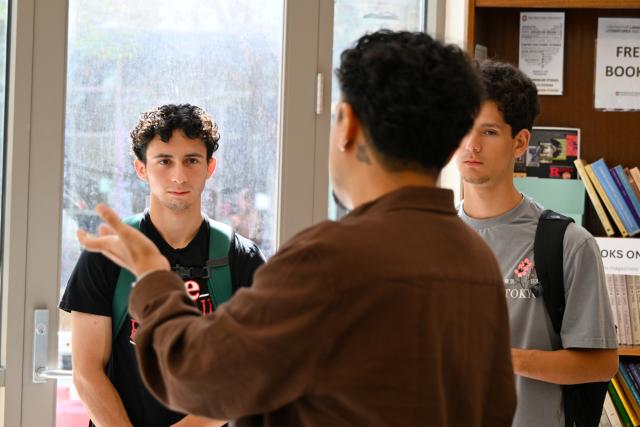
“Art is about communication,” he said. “Communication has to do with community. Showing my work here and hearing from people about how they feel when they look at it is especially important to me.”
The residency also gave students another way to engage with the world beyond Ohio State. Not every student has the opportunity to travel internationally, Vieira said, but bringing an international artist to campus can offer some of that experience.
“I’m hoping to bring some of those global experiences to them by having Herbert on campus,” Vieira said. “It’s bringing Latin America to them.”
For students with connections to Latin America, De Paz’s presence could offer something more personal: an opportunity to see their own histories and identities reflected in an academic setting.
That was the experience of Jocelyn Cortes Contreras, a first-generation Latina student majoring in criminology and criminal justice. In her first semester at Ohio State, Cortes Contreras said De Paz’s visit helped her feel represented in a university environment where she does not always encounter people who share her cultural background.
“Herbert De Paz’s visit gave me a sense of community, belonging, and representation,” Cortes Contreras said. “Hearing him speak to Ohio State students about the richness and beauty of Latino/Hispanic culture reminded me of how important it is to have our voices, histories, and identities represented in academic spaces.”
De Paz found meaningful connections beyond campus, too. During visits to two high schools and a middle school, he met students from a variety of cultural backgrounds, including young people navigating the experiences of migration and cultural identity. Conversations about art, ancestry and heritage gave him a deeper understanding of their lives while offering students opportunities to explore their own histories.
He also wanted young people to see that pursuing art professionally was a possibility.
“I tell them, ‘I’m a professional artist,’” De Paz said. “I don’t expect everyone to become an artist, but I want them to see that it’s possible. Sometimes, meeting an artist or experiencing their work for the first time can help someone imagine that path for themselves.”
Those moments of connection are one way De Paz measures the impact of his work.
“When someone is touched by what you do, you feel like your mission is accomplished,” he said.
But the exchange at the heart of the residency did not move in only one direction.
As De Paz shared his work with the Ohio State community, conversations with faculty and students and visits to campus spaces and collections were giving him new perspectives to carry into his artistic practice.
“Being here is expanding my perspective as an artist,” De Paz said. “The people I’m meeting, the research I’m encountering and the places I’m visiting on campus are all giving me new ideas to carry into my work.”
The experience also deepened his sense of connection with people who shared aspects of his cultural background.
“Being here and feeling part of a community, getting in touch with so many students with Latino cultural backgrounds, made me feel like I was in the right place,” De Paz said.
That mutual exchange was part of Vieira’s vision from the beginning. The Visiting Artist Program asks hosts to consider not only how an artist’s presence will benefit the Ohio State community, but also what the artist will gain from the experience.
“We really hope that coming here will also open doors for him,” Vieira said.
What remains after the residency may be harder to measure.
“I hope people remember his work long after his visit,” Vieira said. “I hope something they see or experience reminds them of it. I want them to see Latin America as a rich region, where people are creating art and have stories and experiences to share.”
For De Paz, that hope extends to people who see their own backgrounds reflected in his work.
“I want them to remember who they are,” he said. “I want them to remember the greatness of our ancestors’ art and culture.”
For an artist whose work began, in part, with searching for the stories he wished he had known growing up, helping someone else discover those stories may be the most lasting connection of all.