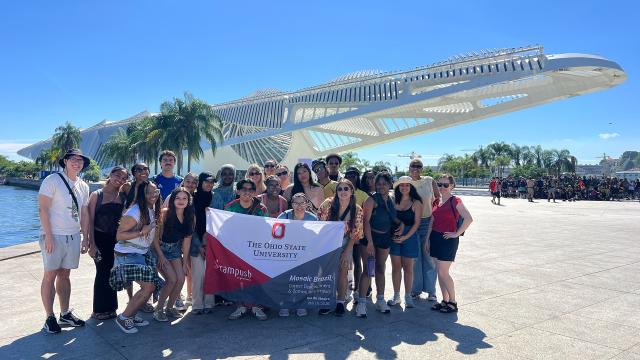
Whether it’s on the streets of Rio de Janeiro or classrooms across the United States, exposing new audiences to diverse cultures and ideas is at the forefront of the Office of International Affairs’ programming.
The Office of Outreach and Engagement recently announced that two initiatives led by the Office of International Affairs were recognized as Programs of Excellence in Engaged Scholarship for 2026.
Awarded annually, these projects demonstrate excellence in community-engaged scholarship and meet the criteria of high-impact engaged scholarship. This year, the Tokaido, Origami, Temples and Shrines (TOTS) and Mosaic Brazil: Career Development and Community Impact programs were recognized.
The Tokaido, Origami, Temples and Shrines (TOTS) project is a collaboration between the East Asian Studies Center (EASC) at Ohio State and the National Consortium for Teaching About Asia (NCTA) at the University of Pittsburgh, which aims to increase understanding of Japan across subject area and grade levels in diverse ways.
The project created a new, visually rich “Virtual Japan Experience” curriculum series developed by a cohort of 12 K-12 and two community college educators who participated in a nine-day experiential learning tour of Japan organized by EASC in summer 2025 to gather resources.
The “Virtual Japan Experience” uses an online platform that can continually expand and incorporate new or updated materials with little impact to budgets, allowing teachers to create their own resources that can be incorporated into the classroom. Through distribution at conferences and the cohort’s own classrooms, the curriculum has reached over 13,000 students across 22 states.
Mosaic Brazil: Career Development and Community Impact began in 2024 and is a collaboration between the Office of International Affairs and the Office of Undergraduate Education. This non-credit, staff-led study abroad experience focuses on fostering academic excellence, intercultural competency, self-management and career and leadership development.
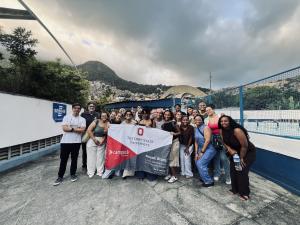
During the week-long program, students collaborate directly with Brazilian peers from the Universidade Federal Fluminese (UFF) in small teams to address real challenges faced by local Rio de Janeiro organizations. Because these organizations operate with limited time and resources, the contributions from these multicultural teams are highly impactful.
“This program broke new ground in Ohio State’s global education portfolio; when it was launched, it was the first non-credit program to be led by staff,” said Jeannie Simmons, Director of Global Education. “When it comes to short term programming, it is also unique to have such robust engagement and collaboration between our students and their Brazilian university peers.”
Before departure, students explore Stakeholder Theory, Brazil’s economic context and cultural norms in four classroom sessions for increased cultural competency. Subsidies from the Office of Undergraduate Education and the Office of International Affairs reduce program fees, making the experience accessible for more students.
“The Mosaic program is transformative for students across their professional and personal goals. We’ve had the privilege to witness their growth through immersion in local organizations and cultures that will have long-lasting real-world impact,” said Global Education Specialist Louise Yahiaoui, who was instrumental in the program’s creation.
All recipients will be honored at the 2026 University Outreach and Engagement Awards ceremony on May 5.