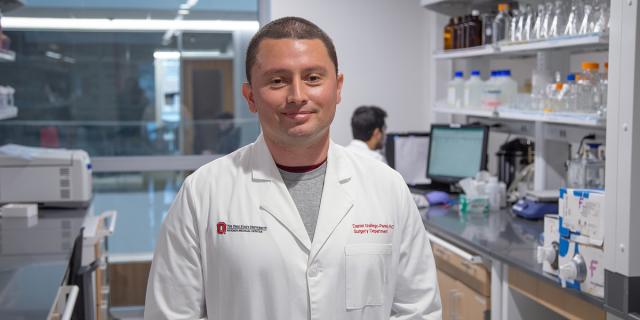
In high school, Professor Daniel Gallego-Perez was drawn to both medicine and engineering as potential careers, but neither quite felt like the right fit.
After learning about a new biomedical engineering degree being offered in his native Colombia, he knew it was the perfect combination of his interests. Gallego-Perez was part of just the second cohort of biomedical engineering graduates from the Antioquia School of Engineering.
Near the end of his undergraduate studies, he spent six months at The Ohio State University as a visiting scholar in Biomedical Engineering Associate Professor Derek Hansford’s lab. There, Gallego-Perez was exposed to microtechnology and nanotechnology, and their impact on therapy development.
“We didn't have a lot of microtechnology or nanotechnology in Colombia back then, so that was something new for me,” he said. “When I returned to Colombia, I made it a point to prepare to apply for grad school and come back to the States to pursue a career in biomedical engineering, focusing on how micro- or nanotechnologies can be used to manipulate cells to develop therapies or to do all sorts of things for medical applications.”
He eventually returned to Ohio State, earning his PhD in biomedical engineering in 2011 and working as a postdoctoral researcher for several years before joining the faculty in 2015.
Becoming a professor wasn’t always the goal. Gallego-Perez was deeply interested in research and enjoyed the freedom academia provides to explore problems of interest. After mentoring students as a PhD student and postdoctoral researcher, teaching also became a passion.
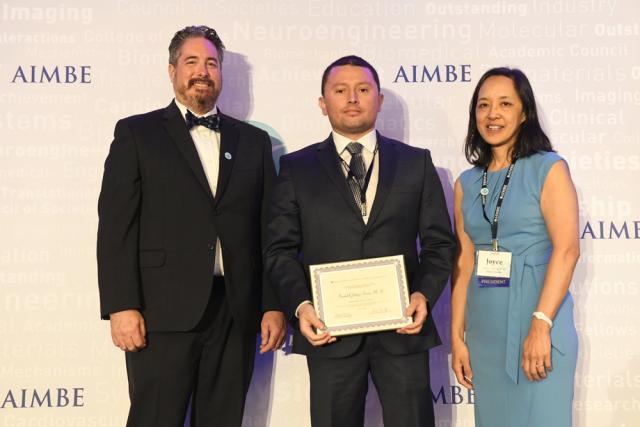
Since 2015, he has advised 18 graduate and 71 undergraduate students and received the university’s Excellence in Undergraduate Research Mentoring Award and the College of Engineering’s Harrison Faculty Award for Excellence in Engineering Education.
“While we take pride in our publications, patents and grants, our most important ‘product’ as a lab will always be our trainees,” said Gallego-Perez, a professor of biomedical engineering and general surgery. “They are the ones who will go on to work tirelessly to make this world a better place for everyone and there is truly nothing more impactful than that.”
His research has also been extraordinary. Gallego-Perez is the lead inventor of tissue nanotransfection (TNT) technology, a groundbreaking platform for non-viral therapeutic gene delivery. TNT uses silicon nanochannels and brief electric pulses to deliver ample amounts of gene copies into tissues to reprogram cells for new functions in milliseconds.
Previous studies have demonstrated how the TNT process may be used to repair injured tissue or restore function of aging tissue, including organs, blood vessels and nerve cells.
“The fact that you can take this technology and then shoot genes into cells and trick them into behaving like different cell types to drive therapies—there are a lot of applications for that,” he explained.
Gallego-Perez received the NIH Director’s New Innovator Award to advance TNT-driven therapies for ischemic stroke and peripheral nerve injuries. He was also awarded pilot funding through the NIDDK Catalyst Award program to explore TNT-driven therapies for diabetes and metabolic disorders. The technology also shows great promise in treating diseases such as age-related heart disease, cancer and Alzheimer’s disease.
In the case of Alzheimer’s disease and ischemic stroke, where vascular tissue in the brain is compromised, researchers used nanotransfection technology to make skin cells behave like blood vessel cells.
“When we put those cells in the brains of animals that have a stroke or Alzheimer’s disease, we are able to recover the deficits in the circulation they have in the brain. We are able to repair damaged portions of the brain in response to the stroke or the Alzheimer’s disease, and improve motility in mice who suffered a stroke,” Gallego-Perez explained. “We’re also able to improve spatial memory in mice with Alzheimer’s disease.”
The next hurdle for TNT technology is commercialization.
“We've learned that a great idea is not enough to take something to a clinical trial or to patients,” he said. “You need to build partnerships with industry, with business leads, people that have significant experience translating university technologies into actual products and that's where we're at right now.”
His research has resulted in numerous high-impact publications and has generated multiple intellectual property filings and awarded patents, several of which have already been successfully licensed to industry. Gallego-Perez is a Fellow of the Biomedical Engineering Society and the American Institute of Medical and Biological Engineering. His honors include Ohio State's Early Career Distinguished Scholar Award, the Cellular and Molecular Bioengineering Young Innovator Award, and Distinguished Alumni Awards from both his undergraduate alma mater and Ohio State’s College of Engineering.
Gallego-Perez and his team also develop other novel biomedical micro- and nanoscale technologies for fundamental and translational applications. Major areas of emphasis include regenerative medicine, cell and tissue reprogramming, drug and gene delivery, and cancer research.
He collaborates on several projects with his research partner and spouse, Natalia Higuita-Castro, an associate professor of biomedical engineering and neurological surgery at Ohio State.
“We came together from Colombia. We trained together, so we're very used to working together,” Gallego-Perez said. “We never planned to stay here for the long haul. We just came to pursue grad school and to be able to launch our careers here, train people here—it's very unique. Both of us are extremely grateful for the opportunities that we have received.”
Original article by Candi Clevenger, College of Engineering Communications, published on February 27, 2026.