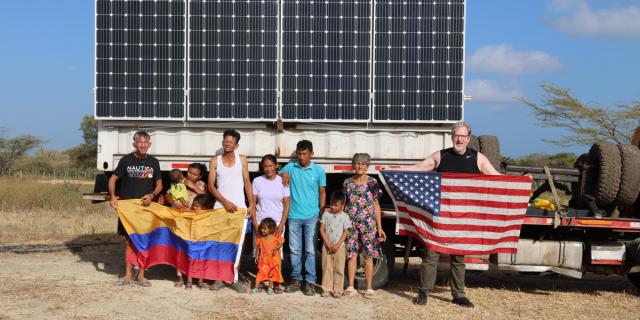
While serving as a visiting professor at the Universidad del Norte in Barranquilla, Colombia, Electrical and Computer Engineering Professor Paul Berger teamed up with a group of regional professors, UniNorte’s Institute of Electrical and Electronics Engineers (IEEE) student chapter, and local stakeholders to help the Wayúu indigenous people who inhabit the Guajira peninsula in northern Colombia.
As many as 5,000 Wayúu children have died over the past decade from malnutrition and lack of medical care. Open-pit coal mining in the region has also polluted groundwater and dried up village wells.
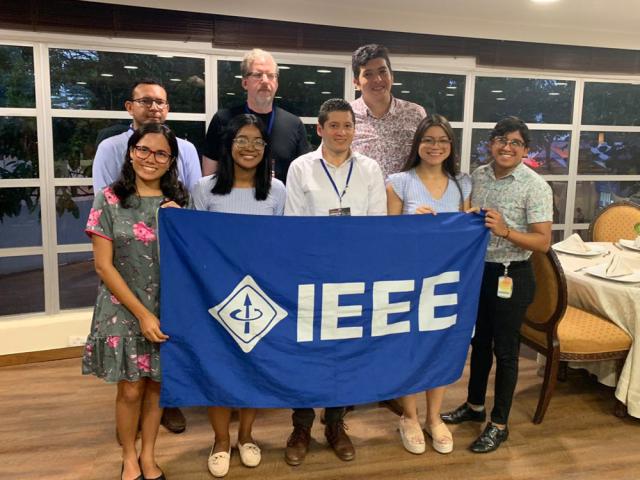
Berger and his team received a $48,000 grant from the Humanitarian Activities Committee (HAC) to carry out an exploratory project aimed at providing fresh, drinkable water to Wayúu communities through the development and construction of a portable solar-powered desalination plant. Two additional augmentation grants from the IEEE Electron Device Society (EDS) added an additional $20,000.
Neil Méndez Túrizo, Renewable Energy Infrastructure Support Specialist for the Department of La Guajira and renewable energy specialist at the Servicio Nacional de Aprendizaje (SENA), served as the team’s direct contact within the peninsula and with local authorities where the project delivery had been planned.
The pandemic directly affected the pilot project schedule in several ways; however, with the help of Carlos Cachazo and Dolcey Torres at SIERGROUP, a Colombian based solar cell installer, and Freddy Fuentes, the local welder Berger connected with during his long stay in Colombia during the pandemic, the team was able to complete the project in 2025. Berger and his team visited La Guajira in August, where they delivered the solar-powered water desalination plant to a Wayúu ranchería to begin on-site operational testing.
Berger stated, “I like to finish what I start, and I had a team that I could depend upon.”
Since establishing a humanitarian engineering working group in 2012, Berger has focused on creating access to solar energy in various communities around the world including projects in Haiti and Tanzania.
Berger’s goal with these initiatives is to establish a chain of international and local humanitarian efforts around the world, addressing the United Nations Sustainability Goals with the help of the next generation of Ohio State. Advancing sustainable, evidence-based solutions through mutually beneficial partnerships begins with engaging native communities in the regions he visits, communities that urgently need solutions to basic unmet needs such as access to clean water and affordable energy.
Original article posted by the Department of Electrical & Computer Engineering in the College of Engineering.
